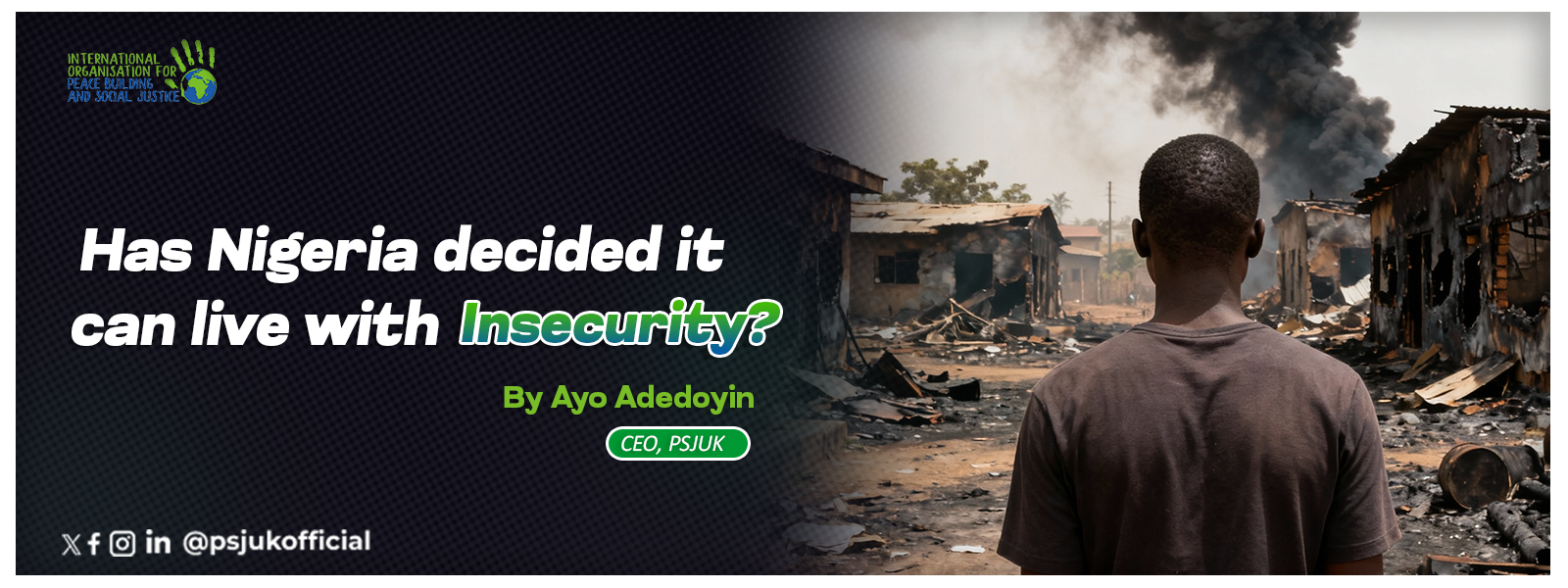
For more than a decade, terrorism has turned Nigeria into a nation at war with itself — from Boko Haram’s savagery ravaging communities in the North-East to so-called bandits and kidnappers in the North-West and on to the Fulani-Ethnic Militias attacking the north-central under the guise of farmer-herder narratives. Yet despite years of multiple streams of bloodshed and anguish, the Nigerian state has not built or led a serious international coalition to defeat these forces. Instead, the government clings to its fragile notion of sovereignty while its citizens cling to survival.
That contradiction lies at the heart of an increasingly urgent question:
Would Nigeria and Nigerians rather live with terrorism than mobilise a global coalition to flush it out?
“Let Them Come — I Just Want Peace”
In a recent PSJUK Roundtable conversation, one participant — a Nigerian lawyer living between Britain and Nigeria — voiced what many citizens feel but rarely say aloud: “If foreign forces can bring peace, let them come. I just want to go home and not be afraid.”
Her words, though controversial, capture a national exhaustion. She acknowledged that Western powers never act without interest — that they, as she put it bluntly, “might not give two hoots about any living Christian” and would surely seek “something in return,” perhaps oil or minerals. Yet her deeper question was devastating: “If the oil wealth has never benefited the average Nigerian, why should we die to protect it?”
That moral fatigue — choosing peace over pride — speaks volumes. Nigerians are not naïve; they know foreign intervention carries costs. But when sovereignty becomes a shield for corruption and complicity, people begin to ask what it is worth.
A Government That Has Lost the Moral Mandate
Another voice in that same dialogue laid bare an open secret: the insecurity industry has become profitable.
“If kidnapping is still a thriving business,” she said, “it’s because some people in power are benefiting. They are the ones in charge of the business.”
Such accusations are not new, but they underline why Nigerians increasingly believe that their government has neither the will nor the incentive to end terrorism. When power protects itself first and the people last, foreign assistance starts to look less like invasion and more like deliverance.
When Sovereignty Becomes an Excuse
Defenders of the status quo often cry “foreign invasion” at the mere suggestion of external involvement. But as another speaker at the meeting pointed out, “Nigeria is already an invaded territory” — overrun by non-state actors, insurgents, and bandit networks that operate freely across its borders. The government’s insistence on self-reliance rings hollow after fifteen years of failure.
He drew a useful comparison: when ISIS ravaged the Middle East, eighty-nine nations formed a global coalition to defeat it. Iraq and Syria did not insist that their sovereignty outweighed the slaughter of their citizens. Nigeria, too, can — and must — mobilise such a coalition if it truly values human life over pride. Regional bodies such as ECOWAS and the African Union could be central to such a coalition, ensuring that Nigeria does not simply outsource its security but anchors any external support within African leadership and oversight.
A People Abandoned by the State
Across Nigeria, ordinary people have learned to live around terror — to plan weddings, burials, and journeys around news of kidnappings or attacks. The country has become desensitised to violence – a ‘learned helplessness’, I argued in a previous article. Insecurity is no longer a shock; it’s a background condition.
That numbness allows leaders to escape accountability. When citizens adapt, governments grow comfortable. When governments grow comfortable, terror thrives.
A Call to Courage and Honesty
The question, then, is not whether foreign powers have mixed motives. Of course they do.
Nigerians are rightly wary of foreign boots on the ground, mindful of painful precedents in other regions where intervention has brought as many problems as solutions.
The question is whether Nigeria’s rulers have any motive left beyond self-preservation. As one participant asked bluntly: “If America has intelligence, the drones, and the capacity to end this, what exactly is Nigeria waiting for?”
If our leaders refuse to seek help, they should be forced to explain why. If they cannot protect Nigerians, they have a moral duty to invite those who can. Pride is not a defence policy.
The Real Betrayal
Every government claims to protect sovereignty. But sovereignty means nothing if the citizens are dying. The betrayal lies not in asking for help — but in allowing a generation to perish out of stubborn nationalism and vested interests.
Until Nigeria’s leaders and people decide that enough is enough, the terrorists will continue to occupy both the forests of Sambisa and the corridors of power.
There is no shortage of international partners who claim friendship with Nigeria and profess a desire to help; what has been missing is a clear, united demand from the Nigerian government and a recognition that ‘All Nigerian Lives matter’.
The world may be getting ready to help. The question is:
"Is Nigeria ready to be saved?"
Credit: Ayo Adedoyin, CEO, PSJUK
International Organisation for Peace Building & Social Justice (PSJ UK) is a UK-based advocacy movement mobilising the Nigerian diaspora and global partners to confront violence, persecution, and systemic injustice in Nigeria. Through research, media advocacy, community action, and strategic engagement with policymakers, PSJ UK amplifies the voices of victims and drives coordinated action for peace, justice, and accountability.
Join the movement and become part of a growing network committed to building a safer, fairer Nigeria
