Terrorism Financing: The Cost of an AK-47 vs the Cost of Living in Nigeria
At an average market price of ₦20,000 per bag, 3,000 bags of maize amount to roughly ₦60 million. Yet the community head, Rabo Sambo, accepted ₦40 million, forfeiting ₦20 million to meet an urgent ransom demand and save lives. Not because the harvest was worth less, but because human lives were worth more. He let go of ₦20 million, money that could have fed families for months, simply to bring their people home alive.
He went from farm to farm, begging farmers to part with the very produce meant to sustain their households. He appealed to donors, to traders, to anyone who would listen. Every bag sold carried a story of hunger postponed, school fees delayed, and futures placed on hold. The entire community paid through its nose, not to build schools or clinics, but to enrich bandits who offered no guarantee, no mercy, and no justice.
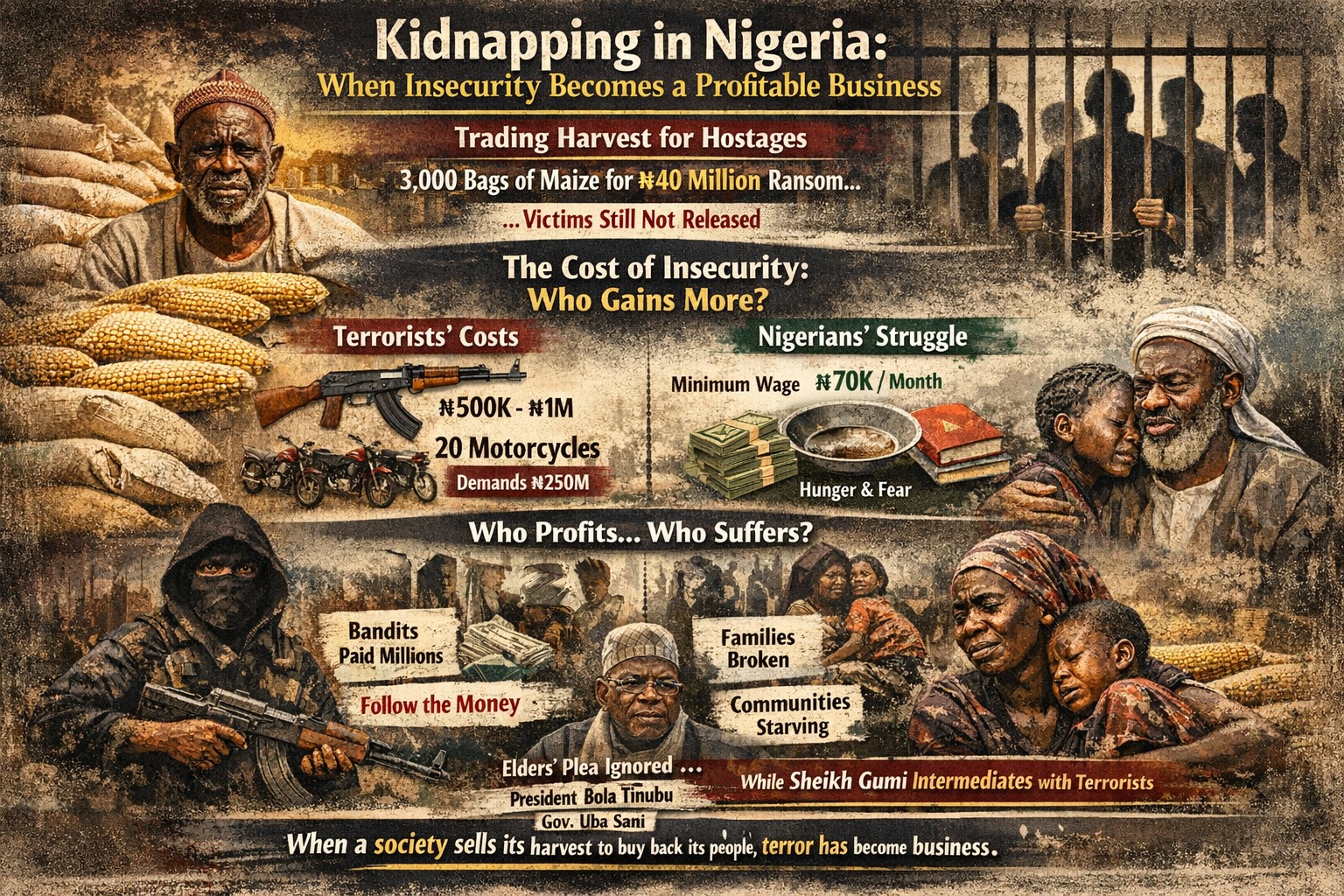
When a society begins to trade its harvest for human lives, something deeper than security has collapsed. Kidnapping in Nigeria is no longer merely a crime; it is an economy, one where fear circulates as currency, and even payment no longer guarantees freedom.
Kidnapping in Nigeria has evolved beyond criminality; it has become an industry. A well-oiled, profit-driven enterprise sustained by fear, silence, and systemic failure. Or how would you classify this? When a community sells its harvest to buy back its people, and still gets nothing in return, we might as well stop calling kidnapping a crime and start calling it what it has become: a profitable business.
On January 18, bandits raised their ransom demand from ₦29 million to ₦250 million and 20 motorcycles, an appalling example of how emboldened and confident these groups have become. In Gidan Waya, Lere Local Government Area of Kaduna State, this anomaly translates normally when an agrarian community reportedly sold over 3,000 bags of maize to raise ₦40 million for the release of 13 abducted villagers. Despite this sacrifice, the victims remain in captivity. What follows is not just grief, but food scarcity, economic collapse, and collective trauma for an already vulnerable community.
The elders of Gidan Waya have cried out to President Bola Ahmed Tinubu and Governor Uba Sani, pleading for urgent intervention. Their pain is not abstract; it is measurable in empty barns, sleepless nights, and unanswered prayers.
The Cost of Insecurity: Who Gains More?
This tragedy forces an uncomfortable but necessary question: who profits, and who pays the price?
Banditry and insurgency are not cheap ventures. Ammunition costs money. Weapons cost money. Logistics cost money. A used AK-47 reportedly sells for between ₦500,000 and ₦1 million, depending on access and supply routes. Compare this with Nigeria’s ₦70,000 minimum wage, which barely sustains food, shelter, and transport, assuming one even earns it. Sadly, millions of Nigerians still earn far less.
Without sustained financial backing running into millions, armed groups cannot operate at this scale. This reality exposes a deeper problem: kidnapping thrives because it is funded, protected, and tolerated somewhere along the line. This is why kidnapping has become so lucrative and so persistent.
Who Profits, Who Suffers?
The victims are predictable: rural communities, farmers, worshipers, corps members, traders, and children. The profits, however, travel invisibly up supply chains that remain largely untouched by accountability. Are there names to pinpoint? And so, we must ask harder questions.
Who Is Sheikh Gumi?
“Nigeria can't trust the US to protect them. What is happening in Nigeria is something we can tackle. It's not beyond our military strength,” says Sheikh Gumi.
It is deeply troubling that an individual widely known as an intermediary between the Federal Government and terrorist groups can operate openly, command respect, and roam freely, while victims rot in forests and families sell their future for ransoms that deliver nothing. When intermediaries gain legitimacy without accountability, the message is clear to all, in that terror pays.
The greatest enemy Nigeria faces is not external. It is the normalisation of violence, the causality of terror, and the dangerous silence of those who know better but say nothing.
Why This Matters
If kidnapping remains profitable, it will expand. If ransom payments replace justice, insecurity will deepen. And if voices of reason retreat into comfort, communities like Gidan Waya will continue to disappear one ransom at a time.
At PSJ UK, we believe peace is not passive. Justice is not optional. Accountability is not negotiable. This is why your voice, your intellect, and your support matter, now more than ever. The only way evil is sustained is because good men say.
