Skip navigation

Understanding the Growing Global Spotlight on Nigeria’s Insecurity: Trump’s CPC Declaration on Nigeria

Over the past few weeks, Nigeria has once again featured prominently in international news — particularly across the United States — following renewed concern about peace and security in the country.

It began with U.S. Senator Ted Cruz sponsoring a bill in Congress calling for Nigeria to be designated as a Country of Particular Concern (CPC) and for sanctions to be placed on officials implicated in the persecution of Christians and other human rights abuses.

Shortly after, former U.S. President Donald Trump raised the issue of Christian persecution in Nigeria during his address at the United Nations General Assembly. This was followed by a letter from 35 U.S. leaders to President Trump, urging him to formally reinstate Nigeria’s CPC designation — a status originally imposed towards the end of Trump’s first term but later removed by the Biden administration under Secretary of State Antony Blinken.

In recent days, the conversation has intensified further, with President Trump reportedly calling on Nigerian authorities to “take out the terrorists threatening Christians in Nigeria.” His comments have triggered widespread debate, with strong opinions emerging on all sides.

Some view the renewed U.S. attention as a welcome step toward justice and accountability for victims of violence in Nigeria. Others, however, express caution — suggesting that such foreign involvement could follow a familiar pattern of Western interference in sovereign African nations, citing the precedents of Iraq, Libya, and Sudan.

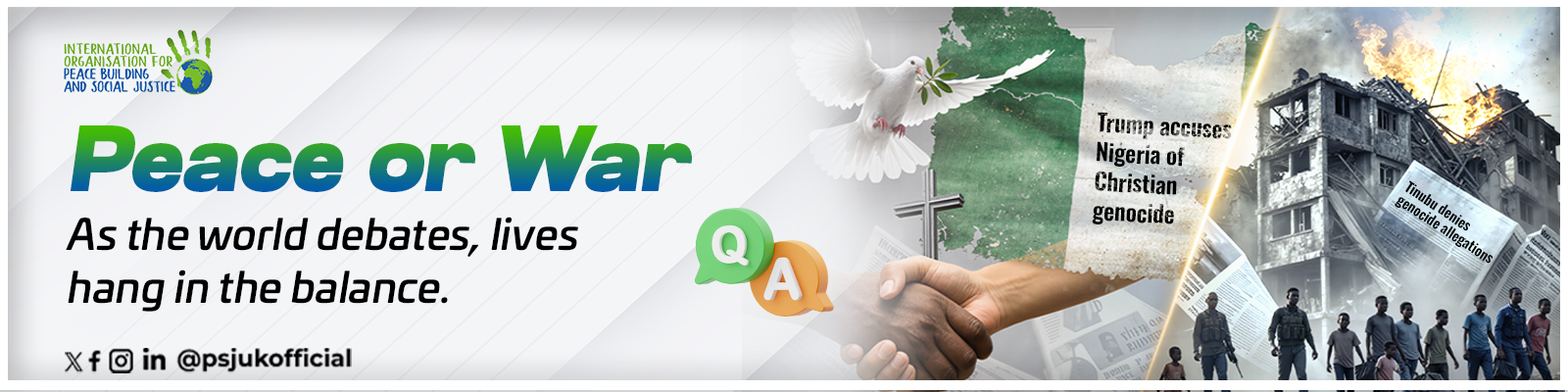
In light of these developments, PSJ UK, which has for years advocated for an end to the killings and persecution in Nigeria, is launching a Q&A platform to help provide clarity, context, and credible information on these unfolding events.

This platform will allow you to:

  • Access verified updates and analysis of global policy developments relating to Nigeria;

  • Ask pressing questions and receive balanced, informed responses; and

  • Engage constructively with others who care about peace, justice, and truth.

We invite you to make use of this resource and share it widely — together, we can ensure that informed, compassionate voices shape the narrative on Nigeria’s future.


Do you have a question on Nigeria that has not been answered below? Enter your question HERE and our Expert Panel will respond

 It means the U.S. government has officially recognized Nigeria as a nation where there are serious violations of human rights and religious freedom.
This designation puts global attention on issues like insecurity, persecution, displacement, and injustice — and opens the door for international pressure, policy changes, and possible humanitarian interventions.
💬 Do you think this move will push Nigeria’s leaders to act differently?

 Nigeria has faced years of conflict, attacks on civilians, religious and ethnic tensions, and limited accountability for violence.

Groups like PSJ UK have documented and advocated around these issues — especially the suffering of communities in the North-East, Middle Belt, and other marginalised areas.


💬 What kind of change do you hope this announcement will bring?

Not necessarily. The designation is a call for change, not punishment.


It signals the U.S. may engage more diplomatically or condition certain aid on improvements in human rights. It could also lead to increased support for civil society and humanitarian groups working to protect vulnerable Nigerians.
💬 Should the international community do more to hold Nigeria accountable?

In the short term, it might not change daily life — but in the long term, it could lead to stronger advocacy, policy reforms, and humanitarian support.
PSJ UK hopes this global spotlight will amplify the voices of victims and survivors and ensure that aid reaches those who need it most.
💬 Do you believe international attention can make a real difference?

PSJ UK has long been advocating for peace, social justice, and the protection of vulnerable Nigerians.


Through our reports, diaspora engagement, and partnerships with policymakers, we’ve helped push Nigeria’s human rights situation into global awareness — and we’ll continue to ensure this designation leads to action, not just headlines.


💬 Would you like to see PSJ UK collaborate with more international organisations on this?

Now that Nigeria has been listed, the next steps depend on how both governments respond.


We’re calling for transparency, accountability, and collaboration — not blame.
This is a chance to rebuild trust, protect human rights, and restore peace for millions of Nigerians.
💬 What’s one change you think the Nigerian government must make immediately?

Your voice matters. Share verified information, speak up for justice, and support organisations working for peace and accountability.
You can also donate to PSJ UK to help us continue our advocacy, research, and humanitarian work on the ground.

His recent public statements and policy moves have prioritised religious-freedom framing that emphasises violence against Christian communities, and his administration (and allied U.S. actors) have re-designated Nigeria under U.S. religious-freedom laws that target “severe violations” — a political decision that foregrounds Christian victims even though analysts say the violence is more complex. Evidence: the White House and allied groups have explicitly framed the issue as anti-Christian persecution; Trump announced a “Country of Particular Concern” (CPC) designation and threatened stronger measures, and conservative advocacy groups and some U.S. lawmakers had pushed for this framing.

https://www.whitehouse.gov/presidential-actions/2025/02/eradicating-anti-christian-bias

The U.S. response has escalated recently because of a combination of (a) renewed political pressure from U.S. lawmakers, advocacy groups and media highlighting attacks on Christian communities, (b) accumulated reporting by commissions and NGOs documenting worsening religious-freedom conditions, and (c) a policy choice by the current U.S. administration to use tools under the International Religious Freedom Act (IRFA) now (e.g., CPC designation, threats of visa restrictions or sanctions). The CPC designation itself is a legal/policy tool that can be (re)applied when the U.S. determines “severe violations” have occurred; political timing and domestic U.S. politics help explain why it was used now.

Yes — civilians of all faiths, including Muslims, are being killed in Nigeria’s violence.
However, the patterns vary by region, actor and motive, so it’s important not to oversimplify.

Both capacity limits and political/operational failures matter. International reports document: (a) serious gaps in security capacity and governance in vast rural areas, (b) uneven law enforcement and prosecution (impunity), and (c) political/coordination problems that frustrate responses, which together make it hard to fully eliminate violent non-state actors. Observers therefore describe a mixture of constrained ability (resource, logistics, governance) and inconsistent political will/priority at different levels.

https://www.amnesty.org/en/latest/news/2025/05/nigeria-mounting-death-toll-unchecked-attacks-armed-groups


Showing 1 reaction

  • Chinecherem James
    published this page 2025-11-03 17:23:35 +0000