
Chinecherem James
-
Total Recruits5016 collected! 32.0% of the goal
-
Chinecherem James published Understanding Nigeria’s Insecurity Crisis in About 2026-03-18 15:40:01 +0000
Understanding Nigeria’s Insecurity Crisis
-
Chinecherem James published Hold Leaders Accountable: MPs Must Address Nigeria’s Security Crisis in UK–Nigeria State Visit: Raising Diaspora Voices for Peace, Security and Justice 2026-03-18 11:37:58 +0000
Hold Leaders Accountable: MPs Must Address Nigeria’s Security Crisis
The President and First Lady of Nigeria, along with senior government officials, are visiting the United Kingdom this week for a series of high-level meetings. This is a unique opportunity to highlight issues that matter deeply to Nigerians at home and in the diaspora.
Nigeria continues to face escalating insecurity, including violent attacks, kidnappings, and threats to civilian safety, alongside pressing governance and accountability challenges. Millions of citizens are affected, and many in the diaspora are concerned about the long-term impact on families, communities, and regional stability.
We encourage you to reach out to your Member of Parliament and ask them to raise key issues during the State Visit
-
Chinecherem James published UK–Nigeria State Visit: Raising Diaspora Voices for Peace, Security and Justice in State Visit 2026-03-17 13:57:40 +0000
UK–Nigeria State Visit: Raising Diaspora Voices for Peace, Security and Justice
As senior UK and Nigerian officials meet during the State Visit, this moment presents a critical opportunity to ensure that the voices and concerns of Nigerians—both at home and in the diaspora—are heard at the highest levels.
This page brings together a series of letters addressed to key UK decision-makers, highlighting urgent priorities around security, governance, protection of vulnerable communities, and long-term stability. These letters reflect a collective call for meaningful engagement—one that moves beyond diplomacy to deliver practical outcomes for those most affected by insecurity and injustice.
We invite you to explore, share, and take action by sending your own messages to ensure that these issues remain central to UK–Nigeria discussions.
-
Chinecherem James published Strengthening Security and Protecting Communities in Nigeria in UK–Nigeria State Visit: Raising Diaspora Voices for Peace, Security and Justice 2026-03-17 13:50:53 +0000
Strengthening Security and Protecting Communities in Nigeria
As part of ongoing UK–Nigeria engagements during the State Visit, the UK Home Secretary, Shabana Mahmood, is meeting with Nigeria’s Minister of Interior, Olubunmi Tunji-Ojo.
This meeting is a key opportunity to address the urgent security challenges affecting communities across Nigeria. From widespread insecurity to the need for stronger institutional responses, millions of lives and livelihoods are impacted.
We are calling on the UK government to act as both a critical friend and a supportive partner, ensuring that discussions go beyond diplomacy and lead to practical, people-focused outcomes.
By sending a message, you are helping to ensure that these concerns are raised at the highest levels and that meaningful action is encouraged.
Ask the Home Secretary to prioritise the protection of communities and the safety of citizens in Nigeria.
-
Chinecherem James published Combat Organised Crime in Nigeria: Write to the NCA Director in UK–Nigeria State Visit: Raising Diaspora Voices for Peace, Security and Justice 2026-03-17 12:37:30 +0000
Combat Organised Crime in Nigeria: Write to the NCA Director
Communities across Nigeria continue to face insecurity driven by organised crime, including kidnapping, trafficking, and illicit financial flows. The upcoming meeting between the UK National Crime Agency and Nigeria’s National Security Adviser is an important opportunity to strengthen practical cooperation.
Your voice can encourage action!!!
-
Chinecherem James published Support Security and Justice in Nigeria: Write to the UK Minister in UK–Nigeria State Visit: Raising Diaspora Voices for Peace, Security and Justice 2026-03-17 10:25:11 +0000
Support Security and Justice in Nigeria: Write to the UK Minister
Communities across Nigeria continue to face severe insecurity, violence, and displacement. Many Nigerians, both at home and in the diaspora—are concerned about the loss of life, weak accountability, and the ongoing lack of trust in justice and protection systems.
The upcoming bilateral meeting between the UK and Nigeria’s National Security Adviser and Attorney General is an important opportunity to address these urgent challenges. Your voice can encourage meaningful action that strengthens security, promotes justice, and safeguards vulnerable populations.
-
Chinecherem James published Stand for Nigerian Christian Communities: Write to the Archbishop in UK–Nigeria State Visit: Raising Diaspora Voices for Peace, Security and Justice 2026-03-17 09:39:48 +0000
Stand for Nigerian Christian Communities: Write to the Archbishop
Many Nigerian communities, particularly Christians in regions such as the Middle Belt, continue to face violence, attacks on villages, places of worship, and clergy, resulting in deaths, kidnappings, displacement, and trauma. These communities often feel unheard, and the protection of civilians, freedom of religion or belief, and long-term security remain urgent concerns.
The Archbishop of Canterbury holds a unique position of moral and spiritual authority, able to speak into issues affecting these vulnerable communities. Your voice can encourage advocacy, protection, and practical support for those most affected.
We invite you to write to the Archbishop of Canterbury
Your message matters. Click the button below to send your letter and show solidarity with Nigerian Christian communities.
-
Chinecherem James published Write to the Foreign Secretary in UK–Nigeria State Visit: Raising Diaspora Voices for Peace, Security and Justice 2026-03-17 09:14:30 +0000
Strengthen UK–Nigeria Relations: Add Your Voice
The UK–Nigeria relationship is strategic and significant, built on shared values, economic cooperation, and strong people-to-people ties. As senior Nigerian representatives meet UK officials, this is a critical moment to encourage meaningful action on issues that affect millions of lives.
We invite you to write to the UK Foreign Secretary, highlighting key priorities for discussion
-
Chinecherem James published When Diplomacy Meets Bloodshed: Can Global Partnerships Help End Nigeria’s Killing? in Article Section 2026-03-16 17:33:21 +0000
When Diplomacy Meets Bloodshed: Can Global Partnerships Help End Nigeria’s Killing?
“What good is diplomacy if it cannot save lives?” That question increasingly shadows Nigeria’s place in global politics.
In 2026, Nigeria presents a striking paradox. On one hand, the government of Bola Ahmed Tinubu is rebuilding diplomatic bridges and projecting an image of economic recovery and international relevance. The recent state visit to the United Kingdom, which is the first in nearly four decades, symbolised a renewed effort to reposition Nigeria as a credible partner on the global stage.
Yet beneath the ceremonial handshakes and diplomatic language lies a troubling domestic reality. Across several regions of the country, violence continues to claim lives, displace communities, and weaken public trust in the state’s ability to guarantee security. Nigeria today stands at a crossroads where diplomacy and bloodshed exist side by side.
The critical question, therefore, is simple: can global partnerships truly help Nigeria confront its worsening security crisis?
Read more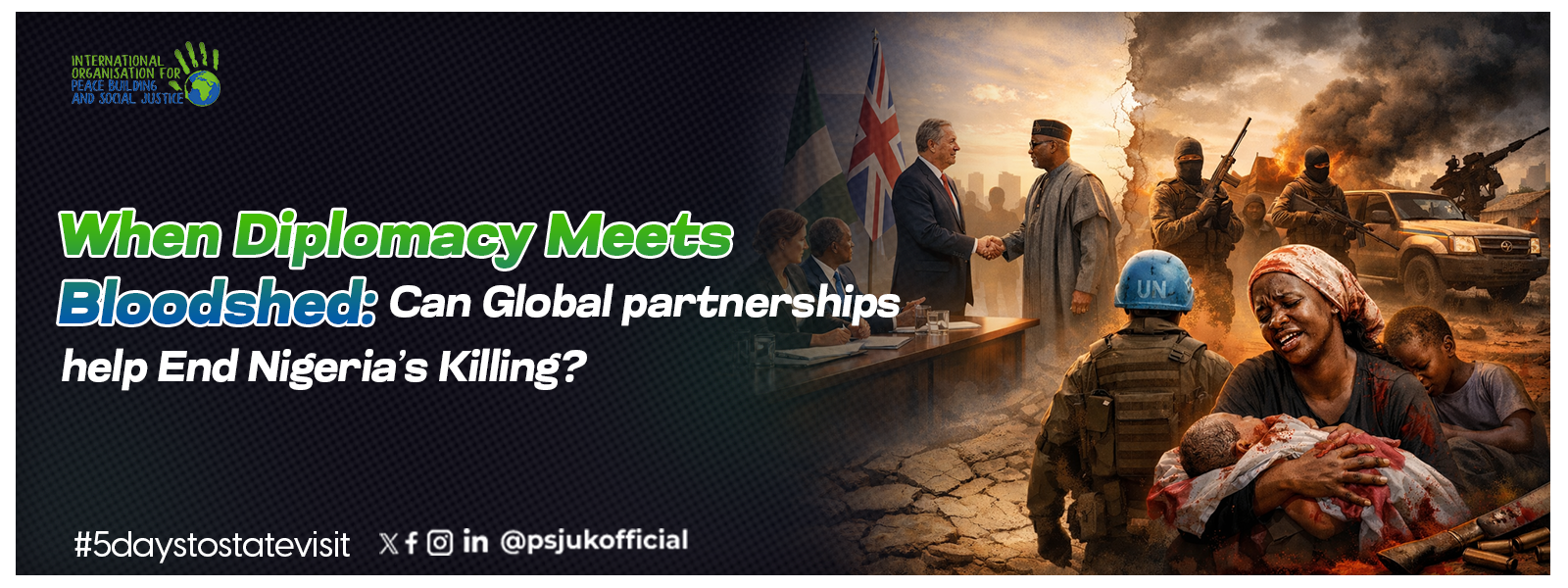
-
Chinecherem James published Write to the NSA in UK–Nigeria State Visit: Raising Diaspora Voices for Peace, Security and Justice 2026-03-16 12:26:51 +0000
Nigeria Security Concerns for UK–Nigeria NSA Meeting…
High-level meetings between UK and Nigerian officials are taking place this week as part of The State Visit. Use this opportunity and this platform to raise urgent concerns about general insecurity, Killings & Abductions across Nigeria, humanitarian protection, and seeming impunity making the crisis worse.
-
Article Section
When Diplomacy Meets Security: What Did the UK–Nigeria State Visit Really Achieve?
Posted by Chinecherem James · March 25, 2026 5:55 PM · 1 reactionFrom Governors to DPOs: A New Grassroots Blueprint for Nigerian Security
Posted by Busayo Omotayo · March 18, 2026 9:35 AM · 1 reactionMore Than a Feast of Meat: Nigeria’s Fourth Feast of Reason at Windsor Castle
See all posts
Posted by Busayo Omotayo · March 17, 2026 4:59 PM · 1 reaction -
State Visit
Welcome to the central hub for all activities, content, and engagement surrounding the UK–Nigeria State Visit. This platform brings together a range of resources designed to inform, mobilise, and amplify the voices of Nigerians at home and in the diaspora during this critical moment of high-level bilateral engagement.
Here, you will find:
-
Articles and briefings offering context, analysis, and policy perspectives on key issues shaping UK–Nigeria relations
-
Letters and advocacy tools enabling you to directly engage UK decision-makers and ensure diaspora concerns are heard
-
Live event updates and streams from key discussions taking place in Westminster and beyond
-
Polls and public input opportunities to capture community perspectives and strengthen collective advocacy
As government leaders meet and decisions are shaped, this hub ensures that the realities on the ground—particularly around security, governance, and the protection of vulnerable communities—remain central to the conversation.
We encourage you to explore the content, participate where you can, and share widely. Your voice is an important part of shaping outcomes that lead to lasting peace, justice, and stability.
-
-
Chinecherem James published The Role of Global Advocacy Movements in Ending Violence in Nigeria in Article Section 2026-03-10 14:47:09 +0000
The Role of Global Advocacy Movements in Ending Violence in Nigeria
“The greatest things in life are at the other end of difficult conversations,” said American negotiation expert Kwame Christian. The most valuable truths are often hidden behind the most uncomfortable conversations. Avoidance may feel like safety, but in reality, it places a ceiling on growth. When individuals and nations lean into advocacy and conflict resolution, they make a conscious decision to exchange temporary comfort for lasting insight.
Read more -
Chinecherem James published Nigeria and the United Kingdom: Understanding the Meaning of the March 18, 2026, State Visit in Article Section 2026-03-09 14:13:10 +0000
Nigeria and the United Kingdom: Understanding the Meaning of the March 18-19, 2026, State Visit
What is a State Visit?
In the language of diplomacy, a state visit is the highest form of international engagement between two sovereign nations. It is not merely a diplomatic meeting or a routine bilateral discussion; it is a ceremonial and strategic event that signals respect, partnership, and long-term cooperation.
Read more -
Chinecherem James published UK–Nigeria State Visit: Public Issues Poll in State Visit 2026-03-02 10:15:35 +0000
Nigeria State Visit to The UK: Public Issues Poll
-
Chinecherem James published When Many Allies Knock: Nigeria’s Counterterrorism Partnerships and the Question of Strategic Alignment in Articles and op-eds 2026-02-22 22:53:31 +0000
When Many Allies Knock: Nigeria’s Counterterrorism Partnerships and the Question of Strategic Alignment
I sat down to reflect on the many bilateral counterterrorism agreements recently signed by Nigeria, and a troubling thought pressed heavily on my mind: when a nation invites multiple allies into its security architecture, does it multiply protection or complicate sovereignty?
As of today, 22nd February 2026, Nigeria’s security diplomacy has gained renewed momentum. Memoranda of Understanding and defence pacts now stretch across global corridors, linking Nigeria with the United States, Turkey, the United Kingdom, France, and Saudi Arabia. On paper, these partnerships suggest a country refusing to surrender to terror. In practice, however, they raise deeper questions about cohesion, loyalty, and long-term national security strategy.
Read more
-
Chinecherem James published PSJ-UK PRESS STATEMENT: U.S. Troop Deployment Reflects Past Governance and Security Failures in Media Release 2026-02-20 19:07:56 +0000
PSJ-UK PRESS STATEMENT: U.S. Troop Deployment Reflects Past Governance and Security Failures
The International Organisation for Peacebuilding and Social Justice (PSJ UK) acknowledges the arrival of United States personnel in northern Nigeria under a limited, non-combat security cooperation framework.
This development has generated significant public debate. Some Nigerians express legitimate concerns about sovereignty, while others view the deployment as long-overdue international engagement in response to a protracted security crisis. It is important to state clearly that the presence of U.S. personnel is at the invitation of the Nigerian government.
Read more -
Chinecherem James published Social Justice in Nigeria: From Rhetoric to Responsibility in Articles and op-eds 2026-02-20 15:12:37 +0000
Social Justice in Nigeria: From Rhetoric to Responsibility
Reflection for the International Day of Social Justice – PSJ UK
Nigeria stands at a defining moment. A nation rich in human and natural resources continues to struggle with poverty, insecurity, youth unemployment, and institutional decay. These are not isolated problems. They are symptoms of a deeper issue: the absence of social justice.
Social justice is not a slogan for commemorative days. It is the foundation upon which peaceful, prosperous societies are built. Where it is absent, instability thrives. Where it is present, development follows.
Read more
This reflection asks five urgent questions: What is social justice? What does injustice look like in Nigeria today? Why has it become pervasive? What are its consequences? And what must be done? -
Chinecherem James published A Defining Moment: Foreign millitary intervention and Nigeria’s security Crisis in Articles and op-eds 2026-02-19 16:47:14 +0000
A Defining Moment: Foreign millitary intervention and Nigeria’s security Crisis
The arrival of United States troops into northern Nigeria has expectedly sparked lively debate. Only half of an expected limited non-combat deployment have landed in Nigeria so far but it does signal a very important new dawn in what PSJUK has been advocating for since we began to mobilise the Nigerian diaspora in the UK along with friends of Nigeria to advocate for peace and social justice in a nation who’s true potential was itself being held captive.
For some, this arrival of US boots on Nigerian soil raises sovereignty concerns. For others, it signals overdue international attention into an existential crisis that has been neither acknowledged nor addressed for far too long.
Read more